From Samarkand Industries OÜ
GamesThe High Table can ban the friend who invited me. That one rule does more work than any moderator could.
I joined expecting a scam, stood near Trinity Square at midnight, and came away impressed and uneasy in roughly equal measure. The company that publishes this page owns the game, which is why you should read the second half.
We own this. Samarkand Industries OÜ publishes Hosaka Seven and also owns what this piece is about. It runs as a house feature: labelled, and kept out of the front page, the section indexes, the feed and the Monday letter, where an independent desk decides what goes. Read it as an account from the inside, and judge it on whether it tells you anything a seller would rather you did not know.
A friend got me in. This is a friend who has, in the time I have known him, given money to a man selling a watch out of a coat, attended a weekend about breathing, and forwarded me a link to a token. He is the most credulous person I like. So when he said there was a secret society running missions in European cities and he could put me in his squad, I assumed I would be writing the short, cruel version of this piece by Tuesday.
I had also written off alternate reality games years ago, on the grounds that most of them are a marketing budget wearing a trench coat. Somebody launches a film, there is a website with a countdown, a forum solves it in ninety minutes, and everyone agrees it was fun without anyone quite having enjoyed it.
I did not hate The High Table. I should say that plainly at the top, because the rest of this is going to read like a prosecution and it is not one.
The rule that made me read the manual
On being invited you swear an oath. That part I expected; every club with a candle has one. What I did not expect was the clause attached to it. Break the rules and you can be banned, and the member who referred you can be banned with you.
I read everything I could get at before I agreed to anything. Not because I am diligent, but because the cost of getting it wrong was no longer only mine, and my friend had been in for a year. That is the whole trick, and it is a beautiful piece of design in the way a mousetrap is beautiful. The operator does not need a moderation team for new members. Every existing member has been given a personal stake in the conduct of the person they brought in, at a cost to the company of one sentence. I have sat in meetings where six people failed for an hour to produce a governance mechanism that good.
Midnight, near Trinity Square
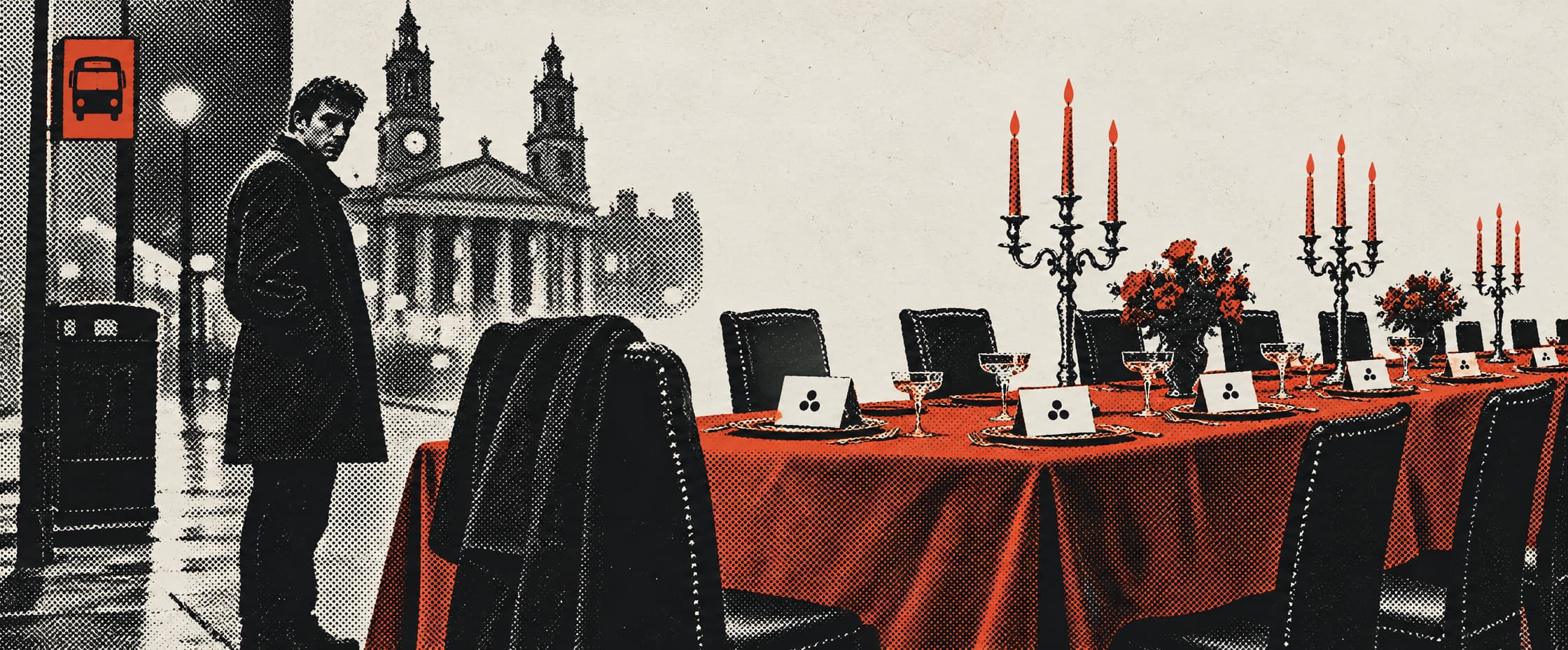
My first mission was called The Night Owl. Midnight, London, a short walk from Trinity Square. I had to find a specific person and complete an exchange with them.
I am not going to say what was exchanged. Not out of loyalty, out of the same instinct that stops you explaining a magic trick to someone who has not asked.
What I will describe is the texture, because it is the product. Some missions are digital only and can be done from a sofa. On the ones that happen in the street, a portion of the membership has a different job entirely: their task is to spot other members and report them for being too obvious. So you are doing a small, banal physical act — standing somewhere, meeting someone, handing something over — while carrying the live possibility that a stranger is watching you do it badly and will be paid for noticing.
It worked. I was discreet, the exchange went through, and my wallet in The High Table's mobile app was credited with QVS, along with points that unlock new skills. I am told roughly a dozen chapters are live around the world and that a few more open each month. A new city begins when The High Table recruits two people to run it, a Concierge and a Sommelier, who apply the rules there.
I enjoyed that night more than I have enjoyed most games this year, and I want to be precise about why, because the reason is slightly unflattering. The thrill is not the mission. The mission was four minutes. The thrill is that afterwards you cannot tell whether the man looking at you across the road is a spotter, a plant from a rival circle, or a man waiting for a night bus who stares at people. The game does not supply that feeling. Your own nervous system does, for free, and the operator keeps the margin.
The game does not supply the feeling. Your own nervous system does, for free, and the operator keeps the margin.
The offer I cannot verify
On a later street mission a stranger approached me and offered me a large amount of QVS to act as a mole for something called The Open.
I have no idea whether that was a genuine recruitment, a scripted test of my oath, or a player freelancing for reasons of his own, and I want to be clear that I still do not know. It sent me to the members' library, where archived documents describe The Open as a parallel circle whose stated aims include exposing and dismantling The High Table. Whether The Open exists as anything other than a very good idea in the fiction, I cannot tell you.
What the join page does not say
Two ways in. A waiting list at thehightable.international, or an invitation from a member into their squad. That is it.
The public join form asks for an email address, a city, a codename of three to twenty-four characters, how near you are to that chapter, whether you would rather work at the screen, in between, or in the street, and confirmation that you are eighteen and accept the terms. Submit it and you are told your request is logged and you will be contacted when your chapter opens. It also mentions a "marker" code handed out by hosts and typed into the app. Amsterdam, London and Tokyo are named. I have not opened the terms and this piece says nothing about them.
Here is what the page does not mention: QVS. The Concierge and the Sommelier. Price.
The currency you will be paid in, the two ranks that run your city, and whatever a seat costs are all invisible until you are inside. Somebody joining that waiting list is accepting terms for a thing whose economy and command structure are not described anywhere they can read first. I understand the reason — a secret society that publishes its org chart is a trade association — and I still think it is the part a buyer should notice. The scarcity is not a side effect of a small operation. A waiting list and a nomination is exclusivity sold as exclusivity, which is a pity, because the good bit of that night in London was the street, and the street is free.
The questions I could not answer
This publication is read by people who sign off on risk, so let me hand them the gaps rather than pretend I filled them.
I do not know what QVS are ultimately worth, or whether they convert into anything.
I do not know what happens to a member who becomes genuinely frightened — not pleasantly unnerved, frightened — by the sense of being followed or watched, or what the design does for them at that moment. I was never frightened. I am not the test case.
I do not know what exists for the bystander. The man at the bus stop did not consent to be atmosphere in anyone's game, and on the evidence of my own evening he never will be asked.
And I do not know how a ban is appealed, or a dispute settled, which matters more than it would elsewhere, because the penalty is designed to fall on two people and only one of them did anything.
The company that publishes this page owns the game and advertises it in the house slots on this site. Nobody at The High Table saw this before it ran, and the label above the headline is there so you do not have to take my word for that.
None of which stopped me standing on a pavement at midnight with my heart going, doing something small and secret, and walking home pleased with myself. That was real. It is just not the same measurement as whether the thing is safe, and I would rather you had both numbers than the one I liked.
Written from
Primary The document itself. Claims in this piece rest only on these.
- The High Table, public site and waiting-list pageThe join page was opened for this piece. It is a waiting-list form asking for an email address, a city chapter, a codename of 3 to 24 characters, proximity to the chapter (in the city, within reach, a visitor, far), a preference between working 'at the screen', 'in between' or 'in the street', and confirmation of being 18 or over together with acceptance of terms. On submission it states that the request has been logged and that the applicant will be contacted when their chapter opens. It also refers to entry by a 'marker' code handed out by hosts and entered in the app. Amsterdam, London and Tokyo are named publicly as chapters. The terms themselves were not opened for this piece and nothing here characterises them. The page carries no mention of QVS, no mention of the Concierge or Sommelier roles, and no price.
- The author's own participation as a member, 2026Everything in this piece about the oath, the referrer-ban rule, the mission called The Night Owl, the spotters, the QVS and skill-point rewards, the approach by a stranger offering payment to act for The Open, the archived material in the members' library, and the count of live chapters and the Concierge and Sommelier roles that open a new one, rests on the author's own experience and on what the author was told inside the game. None of it was independently verified. Some of it is by design unverifiable: an account of a secret is a secret's account of itself.
- Ownership disclosureSamarkand Industries OÜ publishes Hosaka Seven and owns The High Table, and promotes it in the house slots on this site. The piece is tagged house-feature and carries the label. It was not shown to anyone at The High Table before publication.