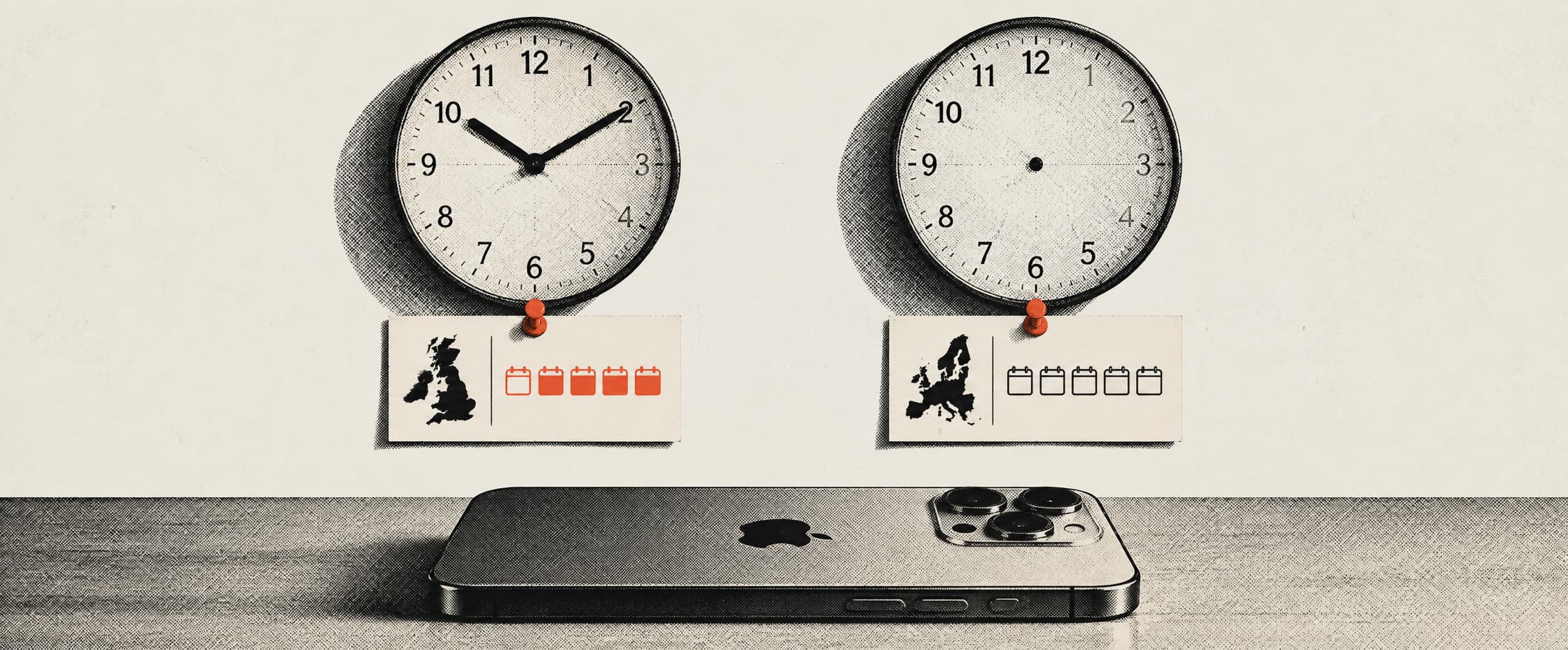
Apple has committed to the iPhone 18 Pro until 18 September 2031 in Britain. Its European clock has not started.
Both declarations are signed, both promise five years, and they count from different days. The same sheet that says so gives the phone 1.00 out of 5 for the length of its software support.
Two phones went on sale on 18 September. One is 6.3 inches and starts at $1,199, the other is 6.9 inches and starts at $1,299, and apart from the size they are the same object: aluminium unibody, Ceramic Shield back, IP68 to six metres for half an hour, a chip Apple calls the A20 Pro. If you are holding last year's Pro, nothing about the enclosure will change how you live with this one.
The interesting thing this cycle is small, and it is on paper. Apple has filed two declarations about how long these phones will be supported. Both are signed, both say five years, and they do not end on the same day.
Two clocks, one phone
The British one is a date. Apple's statement of compliance under the UK product security regulations, signed on 7 August, gives model A3714 a first supply date of 18 September 2026 and a defined support period of a minimum of five years from that date. That is 18 September 2031. You can put it in a schedule.
The European one is a formula. The product information sheet Apple files under the EU energy labelling rules gives the same model a minimum guaranteed availability of operating system security, corrective and functionality updates of five years — and prints underneath it the line that does the work: from the date of end of placement on the market. The European floor does not begin until Apple stops selling the phone. If that is autumn 2027, the floor is autumn 2032. If the model hangs on in the line-up at a lower price for another two years, it is later again.
A date can go in a procurement schedule. A formula cannot.
Neither number is a promise to ship anything. The ecodesign rule the European figure answers to is conditional on its face: if the manufacturer provides security, corrective or functionality updates, it must provide them free, to every unit of the model, for at least that period. It is a duty about how you treat updates, not a duty to write them.
United Kingdomfrom first supply
European Unionfrom end of sale
Class C is arithmetic, not an opinion
Both phones carry a repairability class of C and an index of 3.14 out of 5. The sub-scores are identical across the pair, which is what you would expect of two sizes of one design.
| Axis | Score |
|---|---|
| Disassembly depth | 2.75 |
| Fasteners | 3.80 |
| Tools | 2.55 |
| Spare parts | 4.00 |
| Software updates (duration) | 1.00 |
| Repair information | 5.00 |
Two of those moved since the sheet Apple filed for the iPhone 17 a year ago: fasteners from 3.20, and tools from 1.00 to 2.55. Disassembly depth did not move at all. The tools number is the one worth holding on to, because it is the only line on the sheet that describes what happens when you sit down with a phone and try to get into it.
That comparison is not like for like. A3520 is the iPhone 17, not the 17 Pro; it is the 2025 sheet I could retrieve. I could not pull a product information sheet for any iPhone 17 Pro model number, so there is no Pro-to-Pro figure here.
Software updates scores 1.00 out of 5 because five years is the statutory minimum and the minimum is what a one earns. Apple in practice supports iPhones for considerably longer than five years, and everybody knows it. The sheet is still the commitment, and the sheet says five. The same sheet puts the minimum supplier guarantee at twelve months.
The thousand cycles are a price
Field seven of the sheet reads: battery user-replaceable, no. Directly beneath it Apple prints the four-part test it is answering — fasteners resupplied or reusable, basic tools, a use environment, a layman.
There is a second way to pass. The ecodesign regulation lets a manufacturer skip the layman test if the battery holds at least 83 per cent of rated capacity after 500 full charge cycles, reaches at least 1,000 cycles with at least 80 per cent remaining, and the device is dust-tight and survives a metre of water for thirty minutes. Apple declares at least 1,000 cycles and IP68 to six metres.
So the thousand cycles are not generosity. They are the price of the exemption, and Apple paid it. The same three conditions buy something else in the same instrument: a manufacturer meeting them may supply replacement batteries to registered professional repairers only, and not to the person who owns the phone. Apple does not take that one — the sheet points at Self Service Repair for parts, instructions and indicative prices. It could.
The battery in the smaller phone is 4,056 mAh and the bigger one 5,391 mAh, and under the EU's standardised test they run 52 and 62 hours per cycle. Apple's own release says 36 and 45 hours of video playback. Those are two different tests measuring two different things, and only one of them is on a form.
February 2027
Article 11 of the batteries regulation applies from 18 February 2027, five months into these phones' retail life. It requires that portable batteries in products placed on the market be readily removable and replaceable by the end user at any time during the product's lifetime — with commercially available tools, and without proprietary tools, thermal energy or solvents. The derogations are narrow: appliances built to be splashed or rinsed, and certain medical devices. There is no thousand-cycle route.
An iPhone 18 Pro sold in the EU in March 2027 is a product placed on the market after that date. Whether Article 11 reaches it, or whether the ecodesign exemption continues to govern, is not answered in either text. Article 11 says it operates without prejudice to provisions giving a higher level of protection elsewhere in Union law on electrical equipment; the ecodesign route gives a lower one. I could not find guidance that closes the question, and I would not guess at it in print.
What is decided is the phone. It is a good one and it comes apart no more easily than last year's. What is not decided is which of two instruments governs it in five months, and what date the European five years starts from. On the British form the answer is a day. On the European one it is a formula, and the variable in it is a decision Apple has not taken yet.
Written from
Primary The document itself. Claims in this piece rest only on these.
- Product Information Sheet, model A3714 (iPhone 18 Pro), Commission Delegated Regulation (EU) 2023/1669Read in full. Every figure attributed to the sheet in this piece comes off it directly: battery user-replaceable no; battery endurance per cycle 52 hours 0 minutes; endurance in cycles at least 1000; rated capacity 4056 mAh; repeated free fall at least 180 falls without defect, class B; IP68 to 6 m; Mohs 5; minimum guaranteed availability of operating system security, corrective and functionality updates 5 years, with the note that this runs from the date of end of placement on the market; repairability class C; index 3.14/5 with sub-scores 2.75 disassembly depth, 3.80 fasteners, 2.55 tools, 4.00 spare parts, 1.00 software updates, 5.00 repair information; supplier guarantee 12 months. The sheet identifies the product only as A3714; the mapping to iPhone 18 Pro is Apple's own, from the model numbers printed on apple.com's iPhone 18 Pro technical specifications page.
- Product Information Sheet, model A3717 (iPhone 18 Pro Max), Commission Delegated Regulation (EU) 2023/1669Read in full. Differs from the A3714 sheet on two lines only: battery endurance per cycle 62 hours 0 minutes and rated capacity 5391 mAh. Every repairability figure, the class, the index and all six sub-scores are identical to the smaller model's, which is the basis for the claim in the body that the pair score the same.
- UK PSTI Connectable Devices Statement of Compliance, model A3714Read in full. Source for: software iOS 27.0 and later; first supply date 18 September 2026; defined support period minimum 5 years from the first supply date; signed 7 August 2026 by a named Apple engineering manager in London. The 18 September 2031 date in the headline is arithmetic on those two lines and nothing else. Not read: the equivalent statement for A3717, which an editor should pull before publication in case its first supply date differs.
- Regulation (EU) 2023/1670, ecodesign requirements for smartphones, mobile phones other than smartphones, cordless phones and slate tablets, Annex II Part BRead. Annex II point B 1.1(5)(c) sets the two routes on battery replacement and its second route is quoted in substance: 83 % remaining capacity after 500 cycles, a minimum of 1 000 cycles with at least 80 % remaining, and dust-tight plus immersion to one metre for thirty minutes. Point B 1.1(1)(c)(ii) attaches the same three conditions to the permission to supply batteries to professional repairers only. Point B 1.2(6)(a) is the update duty and its conditional verb — 'if they provide' — is read off the text. Not checked: whether any harmonised standard or Commission guidance published since alters how the cycle test is run.
- Regulation (EU) 2023/1542 concerning batteries and waste batteries, Article 11 and Article 96(2)(a)Read. Article 11(1) is quoted in part and paraphrased for the rest; the derogations described are Article 11(2)(a) and (b) and the safety and data-integrity carve-out is Article 11(3). The application date of 18 February 2027 is Article 96(2)(a), read off the text rather than taken from coverage. Recital 38 supplies the definition of commercially available tools used here.
- Apple debuts iPhone 18 Pro and iPhone 18 Pro MaxPrimary only as the manufacturer's own statement of its own prices, dates and claims, and treated as such. Source for the US starting prices of $1,199 and $1,299, the storage tiers, the A20 Pro chip, the pre-order date of 12 September and availability from 18 September. The video playback hours are Apple's own measurement under Apple's own conditions and are named as a marketing claim in the body rather than set against the EU figure as though the two were comparable. No performance, camera or thermal claim from this release is repeated as fact.
- iPhone 18 Pro and iPhone 18 Pro Max technical specificationsSource for display sizes of 6.3 and 6.9 inches, aluminium unibody enclosure, Ceramic Shield back, IP68 rated to a maximum depth of 6 metres for up to 30 minutes under IEC 60529, and for the model numbers A3714 and A3717 that tie the regulatory sheets to the retail products.
- EPREL product fiche 2402623, model A3520 (iPhone 17)Read in full. Source for last year's figures used in the comparison: repairability index 2.82, tools 1.00, fasteners 3.20, disassembly depth 2.75, spare parts 4, software updates 1, repair information 5, rated capacity 3692 mAh, endurance 41 hours, class B falls, IP68. A3520 is the iPhone 17 and not the iPhone 17 Pro, which the body says plainly; it is the 2025 sheet I could pull and the comparison is flagged in the text as not like for like. I could not retrieve a product information sheet for any iPhone 17 Pro model number, so no Pro-to-Pro comparison is printed.
- Whether the ecodesign battery-endurance route survives Article 11 of the batteries regulation from 18 February 2027This is the gap the last section turns on and I could not close it. Article 11(1) of Regulation (EU) 2023/1542 is expressed to be without prejudice to provisions ensuring a higher level of protection in Union law on electrical and electronic equipment; the route in Regulation (EU) 2023/1670 that lets a manufacturer avoid layman-replaceable batteries is not a higher level of protection, so on the face of the two texts it does not displace Article 11. I found no Commission guidance, notice or FAQ resolving the interaction and have not seen one. If such guidance exists, the closing section is wrong and needs rewriting rather than hedging.
Lead Pointed us at the story. Nothing here is cited as authority.
- Trade coverage of the iPhone 18 Pro EU repairability ratingPointed at the story and at the existence of the product information sheets. Not cited and not relied on. A figure for the iPhone 17 Pro repairability index circulates in that coverage; it is not printed here because I could not read it off Apple's sheet or off EPREL.